Selecting Sheltered High-Altitude Bivouac Ledges
An unplanned bivouac at 4,000 meters in sub-zero alpine conditions is not merely uncomfortable; it is an existential physiological crisis. Core hypothermia and frostbite develop rapidly once muscular movement ceases. The difference between an ordeal survived with full physical capability and a life-threatening evacuation hinges on rapid site selection, structural anchor integrity, and stopping convective and conductive thermal transfer.
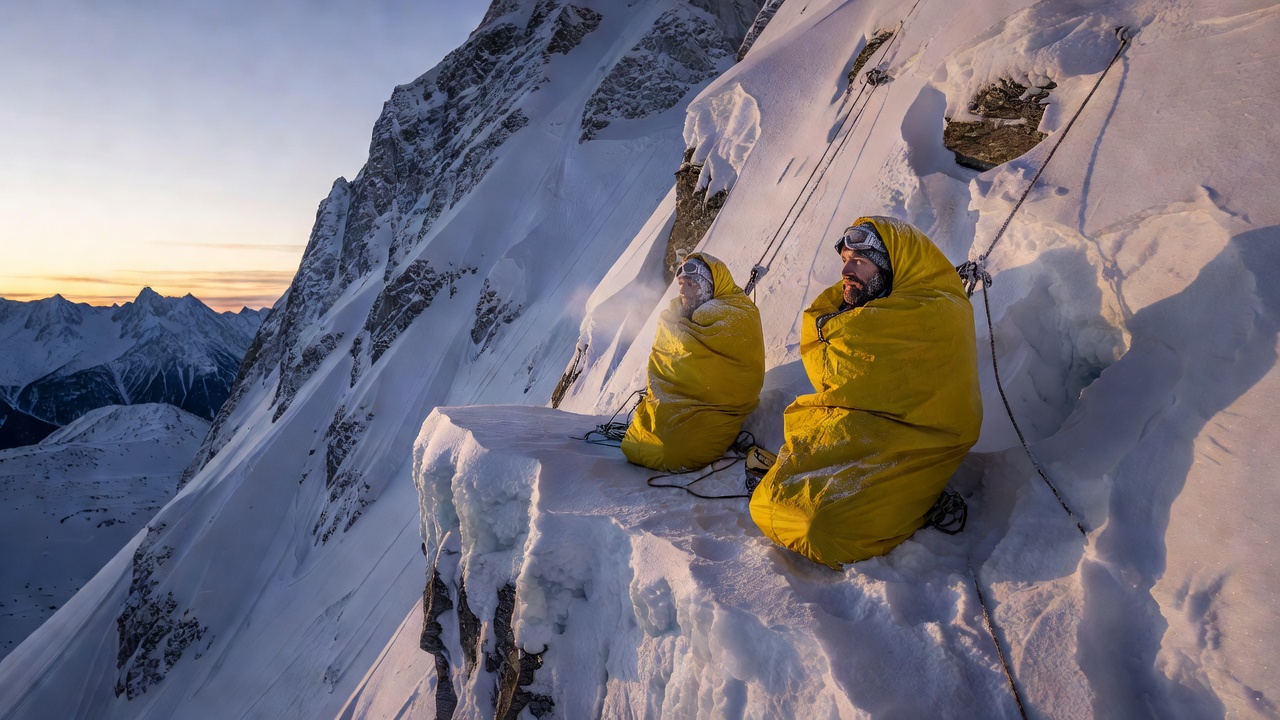
Terrain Morphology: Natural Overhead Protection
When selecting a bivouac platform, the primary threat before darkness settles is objective rockfall and spindrift avalanches. Gulleys and couloirs that stay frozen during daylight hours often spit dangerous ice shards as ambient temperature changes warp freeze-thaw bonds.
Topographical Site Assessment Checklist
- Rock Roof Rooflines: Choose platforms beneath bulging granite overhangs or roofs that direct falling stones outward beyond the ledge footprint.
- Bergschrund Lip Inversion: When stranded on open snowfields, dig directly into the upper lip of a bergschrund or transverse crevasse, creating a sheltered snow bench insulated from wind velocity.
- Windward Ridge Avoidance: Avoid camping directly on corniced crests. Drop down at least 15 to 20 meters onto the leeward slope to bypass catastrophic ridge jet-stream gusts.
Harness Anchorage and Multi-Point Master Stations
Never detach your harness from the mountain system during a high bivouac. Both climbers must remain permanently tethered to an equalized three-point anchor station throughout the entire night.
Conductive Insulation and Hydration Efficiency
Rock and hard snow conduct heat away from the human body over 25 times faster than still air. Sitting directly on frozen terrain will exhaust an alpinist's glycogen stores within four hours as shivering thermogenesis tries to compensate.
| Thermal Layer Element | Material Specification | Survival Functionality |
|---|---|---|
| Ground Isolation | Closed-cell foam pad + climbing pack under buttocks | Stops direct conductive body heat drain into ice/rock |
| Outer Vapor Membrane | Waterproof-breathable single-wall bivy sack | Blocks wind chill convective heat stripping and moisture |
| Internal Thermal Shell | 850-fill hydrophobic down or high-loft synthetic parka | Traps boundary layer warm air around core organs |
| Hydration Maintenance | Hanging stove system melting firn snow | Prevents dehydration-induced peripheral vasoconstriction |